Wednesday, December 5, 2007

Prague Castle, St. Vitus's Cathedral, Basilica of St. George

Several of the best things to see in Prague are in the Castle. I suggest going early, there are lots of people, even on a cold November day. If you need food, find someplace well away from the castle to eat, prices get ridiculous in that part of town. I also suggest going through the front section on the western face, and not through the back section, even though the eastern steps are closer to the river. A great spectacle is the changing of the guards at noon. A mini-version that happens on the hour, but this one is worth seeing.
Arrive early under the gruesome gate to get a spot in the courtyard. The guards are awesome to watch, but Americans and Brits will definitely notice a difference between the Czechs and their own Marines. Pant cuffs may bag a little at the ankle, there's some shuffling in ranks to evenly space the men, some movements aren't all that snappy, and it's obvious not everyone takes 'coming to attention' as seriously as others. Simply, the Czechs take their duty seriously, but they don't make it the religiously martial ritual that their Anglo brethren do.
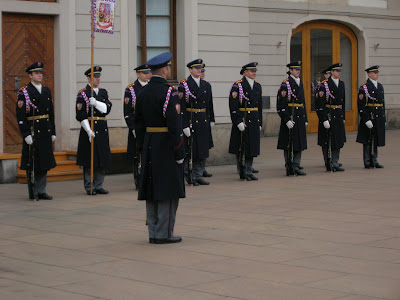
Changing of the Guard
They do however, have a really jazzy bunch of brass to do it to though. And they are a very engaging spectacle. Well worth the watch. I am reminded that at some point I must acquire a sword. For the inside I recommend buying a “Maly” ticket for 250 kc which grants you access to the Old Royal Palace, the Basilica of St. George, and the Golden Lane. The Cathedral is free entry. Order of operations should be something like this: get there at 11:30 to go in and buy ticket, go find spot for changing of the guard. Once done, bypass the Cathedral (everyone is going there), the Palace would be a good option. Then the Cathedral, the Basilica, and the Golden Lane, with a leisurely stroll down the stairs towards the river. This is enough to occupy you for three or four hours if you're a thorough tourist.

The Palace was looted by the Nazis and is fairly small. Don't go in expecting much. I enjoy the idea of a modest monarchy, though. However, it does contain what I'm told is the largest Gothic vaulted space in Europe (or the world, I suppose), and the stonework is quite beautiful. Go upstairs to see the old coal fired ceramic heaters and some documents about failed rebellions. At the far end of the Hall is a small throne room and a church.
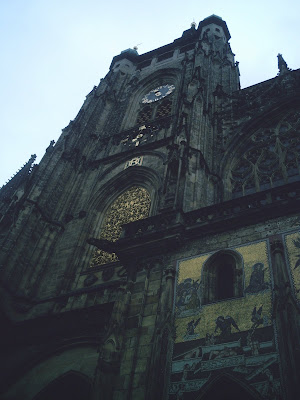

St. Vitus's Cathedral is pretty impressive.
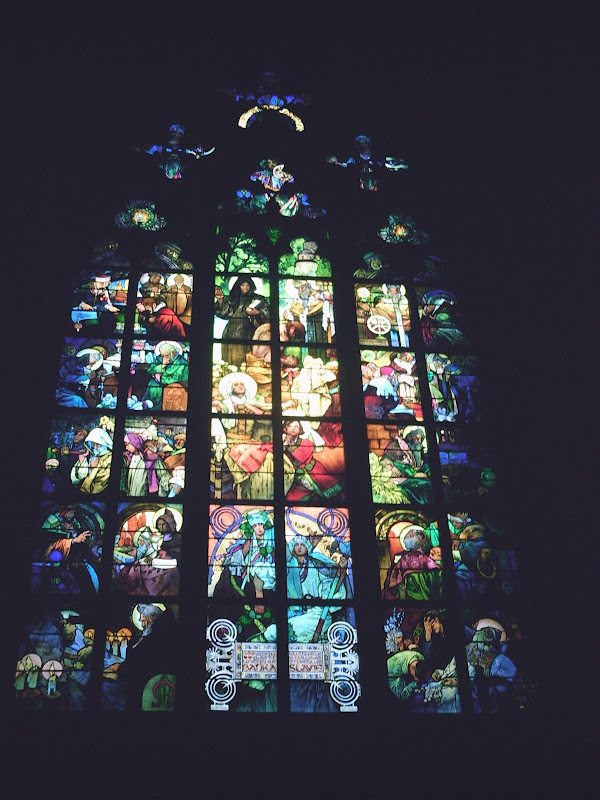
It was 800 years in the making has beautiful stained glass windows, one of them by
Alfons Mucha. I'm not really into the religious stuff, but I dig cathedrals for the architecture and art. Vitus's is pretty cool on both counts.
Halfway down on the right side there is a tower that you can climb. It's something like 287 steps up a spiral staircase. This isn't terrible until you must share this staircase with the people coming down, as well, and you get squeezed to the inside where the steps are only four inches deep. Can be a bit aggravating. The top will be crowded, but it was far and a way the best view of Prague I had the whole time I was there.
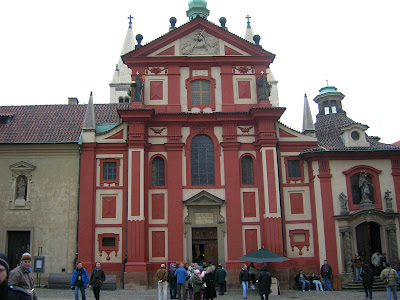
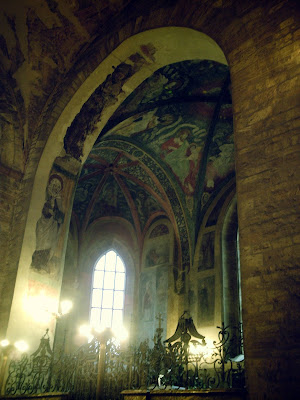
The outside of St. George's Basilica is a lovely red and white, reminding me of an Orthodox church. The inside is very primitive and was severely neglected under Communism, but it still holds a certain majesty. I was quite impressed with the frescoes on the ceiling in the front.

I wasn't too impressed with the Golden Lane. It's a bunch of little cottages built up against/into the outer wall. Once the artisans lived there, especially the gold workers for the monarchy/cathedral (hence the name), and Kafka is supposed to have lived there for a short time. Now it's chockablock with tourist kitsch and the tourists themselves. I'm told I missed the actual historical display part: go left when you get through the gate? Also: don't buy any food here unless you're will to pay true tourist prices. Prague is usually double what things cost in Brno, hot wine or simple food in the Castle is triple.


Friday, November 30, 2007

Prague!

I present to you Prague (the first of several parts):

For travel in the Czech Republic (and maybe the rest of Europe, too) I highly recommend Student Agency buses. Comfortable seats, toilets, movies, free coffee or tea, and English speaking staff are included for less than 200 kc one way from Brno to Prague. They were also quite good when we went to Vienna.

[For geography please refer to the prior map.] Prague is eminently walkable and also quite touristified. There are no shortage of McDonald's, Marks & Spencer's, or any other truly international brand you'd care to name. We arrived in Florenc on the east side of the central city, coming in past Microsoft, HP, and Siemens signs by the highway. The first stretch of town you see walking in is not any more impressive. However, once you get past nam. Republiky things start to look better, older, more European. After a few minutes we arrived at the hostel, squirreled away on a side street just off Old Town Square (Staromestke nam.).

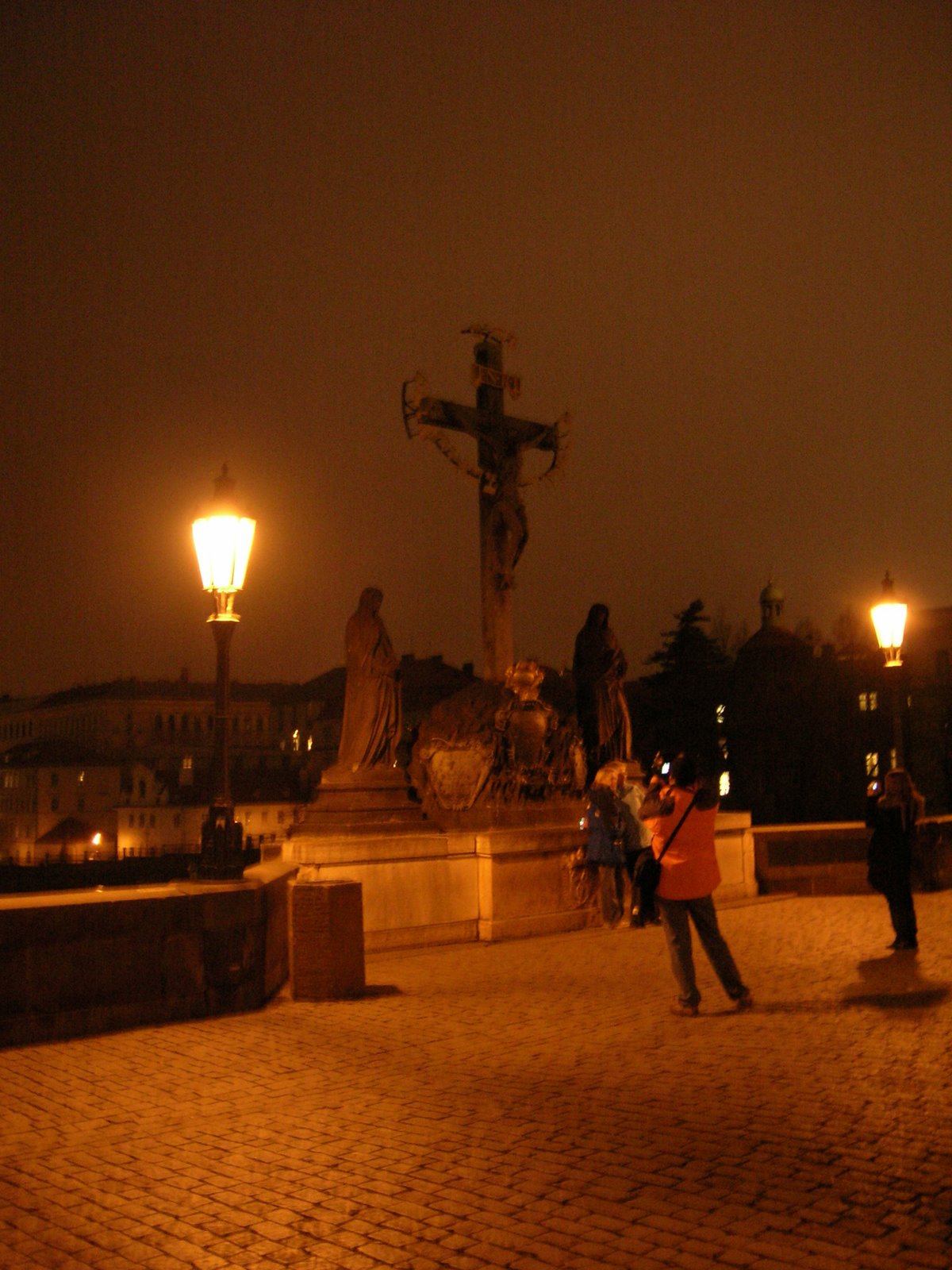
Our Lady Before Tyn on Old Town Square Tyn Hostel is pleasant enough, nightly rates about equal to Brno (which is something of a miracle), if a trifle frill-less. After depositing our belongings we set out in search of grub and a pub. From Old Town Square we stumbled about the tourist quarter to Wenceslas Square (Vaclavske namesti). This 10 minute walk was enough time for Garith to be offered three kinds of drugs by four different people. I dunno I guess he just has that vibe. That 10 minutes were enough to also convince one that a) it was rather cold, and b) that central Prague is for not naught but tourists. We guessed about 40% of the people we passed were speaking Czech and this figure declined throughout the weekend. Upon arrival to the square several of us made purchases from a fast food shack (despite those prices being double what we were used to) and we continued through the bustling mess towards the Charles Bridge. It's quiet at night and quite pretty, though you can't get a real idea of it in the dark. After a few half hearted snapshots we decided that we really didn't want to freeze for that much longer and went in search of beer.

Charles BridgeWhich proved harder than we thought. Not wanting to pay 50 kc for a small Pilsner (that's really highway robbery), we blundered back through the tourist section, past our hostel, and settled into a slightly strange place which was plastered with portraits of starlets from the Golden Age of cinema. However, they closed at 11, only enough time for one beer. Back into the night, past the sports pub playing Rolling Stones, around in circles, into the 'free entry' jazz club. Free entry to bar that is, and 60 kc beers. Definitively a chin-stroking “yazz” joint for expats with too much money. Back out to stand on the corner and debate options.

At which point I hear a bunch of people gabbling in the street and music, too. A couple of us wander over and hear a live band coming from a crowded cellar. The vibe is very much art gallery/hipster houseparty. Down six narrow and steep steps is a vintage clothing store about the size and shape of a small Quonset hut. Immediately to the left was a glass table with two girls in frilly '60's party dresses
pouring the last of a box of wine. Racks of clothing hung all the way down each side, but the middle was taken up with a milling mass of hip young people speaking in some British but mostly American accents. On the far side of the hip young thangs was a band, and such a band. We later learned they were called Duchess & the Kittens. The lead singer was a large girl with a real whiskey voice. Try to imagine Duffy Bishop and Dr. John having a lovechild. Then get that person seriously trashed and you might have an idea of what she sounded like. The band was an electric bass, a banjo, and a sax. They were doing tunes appropriate to the clothing. The name of the place turned out to be Laly, though I didn't really learn anymore than that.

Maria had decided she'd had enough and went to the hostel. I really wanted to stay, as did Cat. Joe, Garith, and Brian didn't see any fun in that, and Emma went with them to find a pub. As the vintage girls were out of wine Cat and I hurried to the non-stop (24 hour joint) next door and grabbed some liquid refreshment.

The feeling of the place was very comfortable, but deeply strange. I felt like I could have been at a house part in the U District. Most of the crowd looked young enough that they wouldn't be able to drink back home. As soon as I walked in I walked past a knot of fashionably coiffed guys, with attendant women, stridently trashing the band, while said band was playing. I was happy that they left quickly. There were also some oldsters in the crowd, grinning their heads off. And one couple who came dressed for a swing-revival. The band played lots of old standards, Motown kinda stuff, sometimes trading in an acoustic guitar and a steel lap guitar. The sax section magically multiplied. The highlight of the evening was Love Potion No. 9. Oddly enough the Duchess sounded a lot better after her third Jamieson. Go figure. Cat and I were digging it. About 1 am they called it quits, but just long enough to change up. It became Rev. Bob's Revival Hour. One of the sax players came to front and started a “Hallelujah!” schtick. Out of the crowd came a mutton-chopped ska-punk looking guy to take over on electric. Pretty soon there was lots of hollering and 'spiritual' music going. They were pretty good, but took themselves a little too seriously compared to how perverse the lyrics were. Cat and I called it a night here and went round the corner to the hostel.

Prague, a map

Here is a somewhat annotated map of the events in following posts. Probably best to zoom in a little bit.

View Larger Map

On being ill....

...it sucks. Nuff said.

Apologies for the lack of posts in the last week, I've been pole-axed by a nasty strain of flu going round Brno. So nasty that I could neither sit up or see straight on Wednesday morning. Doing better now, but still recovering. I do, however, have time to do some blogging now.

Thursday, November 22, 2007

Some Differences from There to Here

--I have probably mentioned all of these at some point already, but they give a better picture when you stack them on top of one another.--

Distance is both smaller and larger here here. At home a few hours drive would take you across a state, or to a different city, but here a few hours drive will take you to a different sovereign state. Different language, different customs, different money, different wins and loses, and often a different attitude. You man not be able to see the border, but I think they can feel it. Like birds and magnetic north. However, you can scarcely go a kilometer without running into buildings, structures, and accretions of history. Many of them even come with people.

There are not mechanical dryers here. Everything is hung outside in dry weather, and on wire racks indoors when its wet. The preponderance of radiators is good for drying socks or quickening a pair of jeans.

The toilet is always in a different room than the bath. If you're lucky there is a sink in the same room. These toilets tend to have a broad shelf where your offal lands and it is then sluiced down into the hole by water released from a separate tank roughly a meter above the throne. Or more modern toilets have two-part buttons on the top of the tank planted directly upon the throne. Unless you are visiting a building remodeled in the last ten years, the plumbing has a mildew and vinegar odor.

Most bathrooms have no shower curtains. The majority have a shower-head wand on a flexible tube that sticks straight form the top of the faucet. Even tubs that have the hanging rod for a curtain must be used carefully, because a standard shower curtain is not long enough to cover everything.

Water heaters are boxes stuck high on the wall, which ignite with a 'whooomph' when you require their contents.

There are no closets, but wardrobes and built-in shelving abounds. Beds are narrow firm affairs, low to the floor. Its normal not to have a sheet, but just a large fluffy duvet. Herringbone patterned wood panel floors are common. As are electric kettles and one section sinks.

Light switches are black rockers in square white panels. Electrical sockets are round and recessed. They have holes for two circular prongs of identical size.

Houses are not simple one family affairs. Most are row houses, set back a little bit from the street with giant open green spaces on the far side of them. There are at least two flats in every three story building, even if it's only one room in width. You may have a yard, but it could be shared with other people, if you're even allowed in there.

Most everything is made of brick and stone, with stucco type facades. Nice buildings have been painted and colored since the Communists fell, but many are flaking and peeling, dropping sections to reveal their lumpy skeletons. It feels much worse to me than any house with peeling paint. Its even more disconcerting when the building still has all the original carved stone flourishes and cherubs and gargoyles, which are dirty, because they emphasize how nice the building must once have looked.

Monday, November 12, 2007

My Daily Dose

I do, occasionally, take requests!

Webcomics are fun. Webcomics are easy to find. Webcomics can be terrible or wonderful mindcandy. However, they are rarely 'serious art.' I am somewhat addicted because of the variety and the sheer 'hit' you get when you discover one that's new to you. Several years of archives equal a whole afternoon and this afternoon feels like a combination of your favorite TV show, a fun book, and a slot machine. Somewhat dangerous. Many long-running comics require this, however, because of plots more layered than a Paleozoic lake bed in volcano territory and recurring in-jokes. Please note: many of the following works may not be 'work safe' or 'child safe.'

My two favorites are:
Schlock Mercenary, a pirate space opera with tongue planted firmly in cheek. Color, runs 7 days/wk without fail, strip with a Sunday super-size.
-and-
Questionable Content, a bunch of hipster kids with self esteem issues, lots of music references, and talking computer appliances. Color, runs M-F, full page in 3-4 panels.

Some really cool ones to watch:
Templar, Arizona, basically about a kid who ran away from home, but also a cyber-/steam-/crusty- punk in an alternate universe. Large format B&W, updates once or twice a week. It's pretty new, but substantial so far.

xkcd, is a reaaallly nerdy stick-figure strip but it's got a great sense of humor, which makes it very popular. B&W 3-panel, updates 2-3 times a week.

Gunnerkrigg Court
is one I found the other day. Totally safe for kids of the Harry Potter set, which it seems to be targeting. Very whimsical and unpredictable, but pretty creative. A girl is sent to a magical schooling institution. Large format color, updates 2-3 times a week.

All these and other stuff I've made a point to remember is located here.

If you go to any of these comics, they normally have link sections which can lead to some really interesting neighbors. Only half of above list is well-known, but there are some really big names like Penny Arcade, PvP, Devil's Panties, and Sinfest on the far side of the link. There are also a lot of big name/popular works that I'm just not very interested in and haven't referenced, so if you see a name that keeps popping up in link sections, that would be something that the hordes have deemed worthy.

The Search for Society: A Quest for a Biosocial Science of Morality, by Robin Fox

Not much of a week for the Moore-Short blogoshere is it? I'm going to Prague tonight. Updates and such next week For now I stumbled across some old blog stuff I did more than a year ago. An abortive attempt to catalogue all the print and video I was consuming. There are a few interesting entries and I did like this thing:

It starts off with lots of discussion on about long dead European philosophers and the arguments between schools of thought in anthrop- and soci- ologies, but then it gets down to brass tacks with discussions of tribal ('pre-civilized') societies like:

There was never any question that violence was both necessary and useful, and in a very positive sense good - as good as eating, copulation, singing. Only obviously it created more difficulties, because, the possible outcome was the loss of an individual life - which is clearly a difficulty for the group. But when I say this was not a problem, I meant it was not an intellectual problem. I prefer simply to call it a difficulty. One tried to overcome practical difficulties; one did not try to solve intellectual problems.

Again I am not saying that early man never tried to solve intellectual problems. I am merely saying that, unquestionably, he did not create unnecessary intellectual problems where they did not exist. There was for him no intellectual problem of violence; there was for him no intellectual problem of sex. These are late inventions of human self-consciousness, not a necessary consequence of human self-consciousness.
Page 131.

What he's saying is that historically, the human propensity towards violence was a tangible benefit vis a vis our survival.

The problem for the species is not violence itself. The fascination of violence is as real and as profound as the fascination with sex, with food, with the supernatural, and with knowledge, exploration, and discovery. And its satisfactions are of much the same kind. The problem lies with the capacity of the human imagination to create its encompassing, consummatory systems with violence as their focus and purpose. We call these systems battles, wars, pogroms, feuds, conquests, revolutions, or whatever, and therefore what we must understand is that the problem is not violence, but war; the problem is not aggression, but genocide; the problem is not killing, but battle. And into the organization of war, of battle, of genocide, goes far more by way of imaginative energy than physical violence. Indeed, if one were to do an inventory of the energy expended in a war, the actual physical violence would probably amount to very little. And with modern war this is even more striking. Modern war is almost better understood as an aspect of complex bureaucracy on the one hand and artistic capacity on the other.
......
The problem here is not violence. The problem here is the use to which violence is put. The problem with Puritanism is not sex, but the uses to which sex is put in the control of people. The problem for Orthodox Jews is not eating, but the imaginative restructuring of the conditions of eating that the religion demands. The problem is not our violent nature, or even the nature of violence, but our violent imaginations, and our imaginative use of violence: an imaginative use that no longer bears any close relation to the evolved conditions of violence – the conditions in which violence is a contained, normal, explicable, and unproblematical aspect of our adaptational history as a species.
Pages 135-36.

Let's review, yes? Duels with swords and even flintlocks are logical and even desirable from an evolutionary perspective. Nuclear weapons and trench warfare with machine guns is most absolutely fuckin' bad. Maybe we should allow bloodsports? Just saying....


--I never finished the book. In retrospect, this guy was pretty far out there by his colleagues' standards, but seems pretty cool. I think he does, however, make the idea of violence in the modern world (i.e. Iraq, Burma, Darfur) a little to abstract. Of course, he was writing during the Cold War, he might be forgiven a lack of wider perspective.